
Read the Harrison County Tax Record Field by Field
The Auditor's real-property sample card is labeled 2025 assessment, payable 2026. That split matters. Gross assessment, deductions, taxable assessment, rate, installments, total, and balance each sit in their own field, which keeps Harrison County property tax records readable instead of collapsing unlike figures.
| Field | What It Shows | Where |
|---|---|---|
| Gross land and improvement assessment | Component values before deductions | Assessor/Auditor card |
| Deductions | Named reductions applied to the record | Auditor card and exemption files |
| Taxable assessment | Assessment remaining after applicable deductions | Auditor card |
| Gross-tax rate | Rate field tied to the displayed district and year | Auditor tax information |
| Spring and fall charges | Two installments, total, and balance | Treasurer and Auditor record |
Indiana assesses real property at 100% of market value-in-use. The state also studies assessed-value-to-sale-price ratios. Even so, assessed value, market value-in-use, and a recorded sale price remain three different figures. The bill simply applies the year's tax structure to the taxable assessment; it is neither an appraisal nor an asking price.
Use Harrison's Sample Card Without Generalizing It
Harrison County's official sample property card lists two installments of $719.32 each, total charges of $1,438.64, a zero balance, a taxable assessment of $140,280, and a 0.0113950 gross-tax rate. Deduction labels on the card include Standard Homestead and Supplemental HSC. Those numbers exist to show the layout. They are not countywide rates or standard deductions for another parcel.
The sample card also holds the parcel number, Tax ID, map number, legal description, township, tax district, and school district. Keep the original field labels when you copy figures. Extracted columns can make the land, improvement, and total values easy to misread.
Note: A single Harrison tax card demonstrates fields and timing, not what every parcel owes.
Search the Harrison Auditor Roll with the Right Key
The Auditor tax-list page offers three search keys. Choose property or parcel number, name, or property address. It returns a range-limited result set and is marked "Not for Official Use," so confirm consequential tax facts with the office.
| Starting key | Use it when | Check next |
|---|---|---|
| Property / parcel number | The APN is known | Tax year, district, and exact property match |
| Name | The billed party is known | Same-name results and entity variants |
| Property address | The situs is known | Directional, road suffix, city, and ZIP variants |
The Assessor handles prior-year lookups. Supply a property name, address, or Tax ID, and that direct route covers cases the current public list does not.
Follow a Harrison County Tax Bill from Card to Payment
Start with the parcel identity. Then follow the money. Assessment and deduction fields come first, then the Treasurer's collection record, and the Harrison County Treasurer collects property taxes twice each year and coordinates the annual tax sale.
- Locate the exact account by parcel number or address and verify situs, owner, district, and year.
- Read land, improvement, deductions, taxable assessment, rate, and both installment fields.
- Compare payment status and balance through the Treasurer's office or current search route.
- If delinquent, check certification, tax-sale status, redemption, and newer county notices.
- Assessed value
- The value assigned under Indiana assessment rules before deductions are applied.
- Tax rate or levy
- The year-and-district factor used in calculating the bill.
- Homestead deduction
- A qualifying reduction shown as a named deduction on the tax record.
- Tax lien
- A statutory claim arising from unpaid property taxes, not proof that title already transferred.
Understand Harrison's Two Installments and Partial Payments
The Treasurer accepts cash, check, money order, cashier's check, and credit card at in-person, phone, online, and office channels. Mailed payments need a postmark by the due date. Include a self-addressed stamped envelope for a receipt. Write the parcel number on the memo line. Partial payments are accepted except on parcels carrying a tax-sale lien. Confirm processing and any service charge with the office, since payment interfaces and fees can change.
Read the 2025 Harrison Tax-Sale Notice Carefully
A parcel becomes tax-sale eligible in one way. The spring installment, or part of a prior-year installment, goes delinquent. Harrison County certifies eligible property July 1. The county points readers to SRI for the list. The 2025 tax-sale advertisement was dated September 10 and set an October 24 sale. Those dates belong to one cycle. Do not reuse them for a later year.
The notice warns that common or street descriptions and key-number or address errors may not invalidate a sale. Consecutive lists may omit descriptions. A listing marks a collection process, not a completed sale. Redemption, expiration, and ownership change must be traced through Treasurer, Recorder, and court documents. Pair those with sale records.
Track Harrison Assessments Through the 2026 Cycle
Indiana's statewide cyclical reassessment starts July 1, 2026. It opens the 2026 Pay 2027 cycle and runs four years. Counties physically inspect roughly 25% of parcels each year. So one parcel's change can reflect its cycle segment. It might also come from annual trending or new construction. A correction or an appeal can shift a figure too. Every parcel does not change at once.
The DLGF assessment overview covers annual sales research, ratio studies, annual adjustments since 2002, and the market-value-in-use framework, so note the valuation date and tax year before comparing cards.
Challenge a Harrison County Assessment Through Form 130
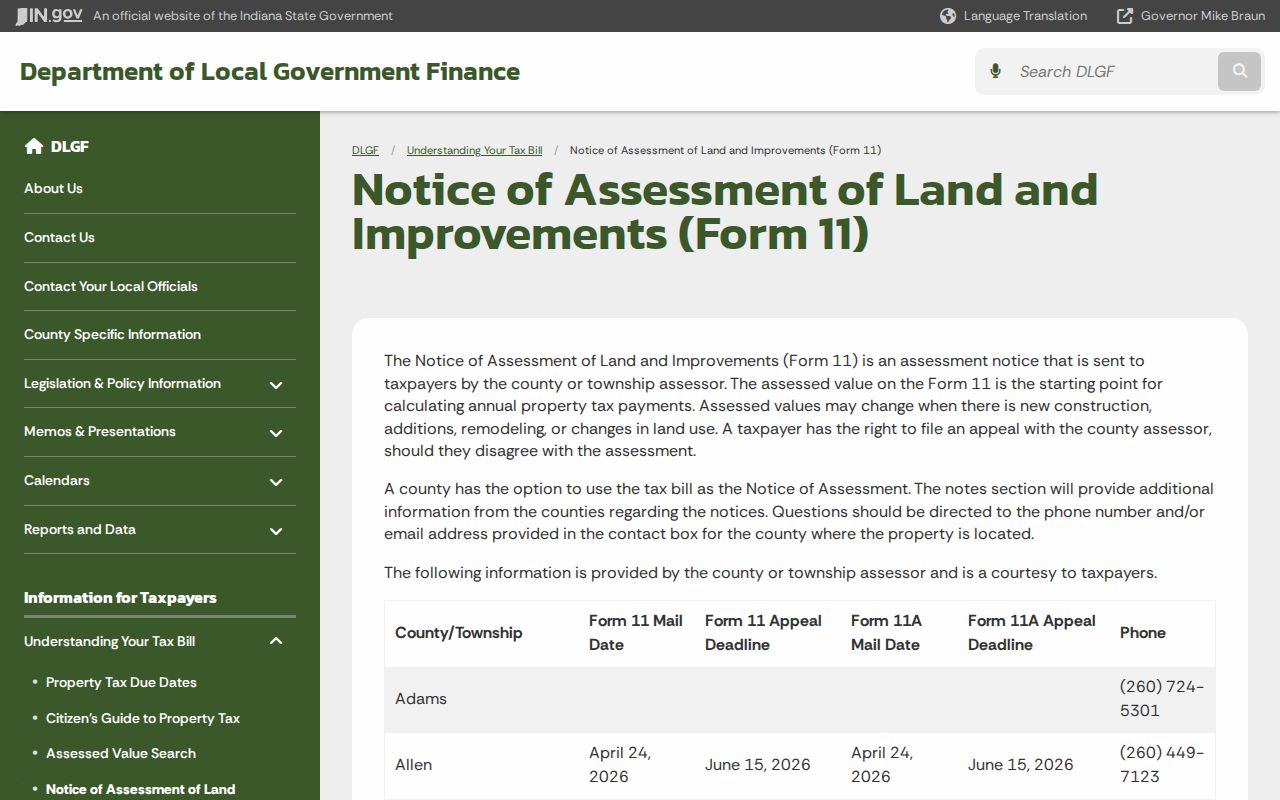
A Form 11 notice starts the annual tax and appeal process. The Form 11 notice page explains this starting point. Before filing, check the record's parcel identity, property description, and land and improvement details. Check the deductions and valuation year, too. Back everything against solid evidence.
The DLGF appeals guide sends a taxpayer to Form 130. It is filed with the local assessing official. Page one handles subjective assessment disputes. Page two covers objective errors. Those errors can include the wrong person. A credit or exemption issue is another. So is a math or typographical mistake, or a property-description error. Objective errors may be raised for up to three years.
From there, the path runs through an informal conference. Next comes the county Property Tax Assessment Board of Appeals. The Indiana Board follows, and Tax Court is the final stop.
Rely on the state's current instructions and the date on your Form 11. A generic annual deadline is not safe. The current Form 11 guidance shows the official starting point:
The assessment notice leads to a decision. Either verify the record's facts or begin a timely appeal, and the state's property-tax appeals page lays out the review path:
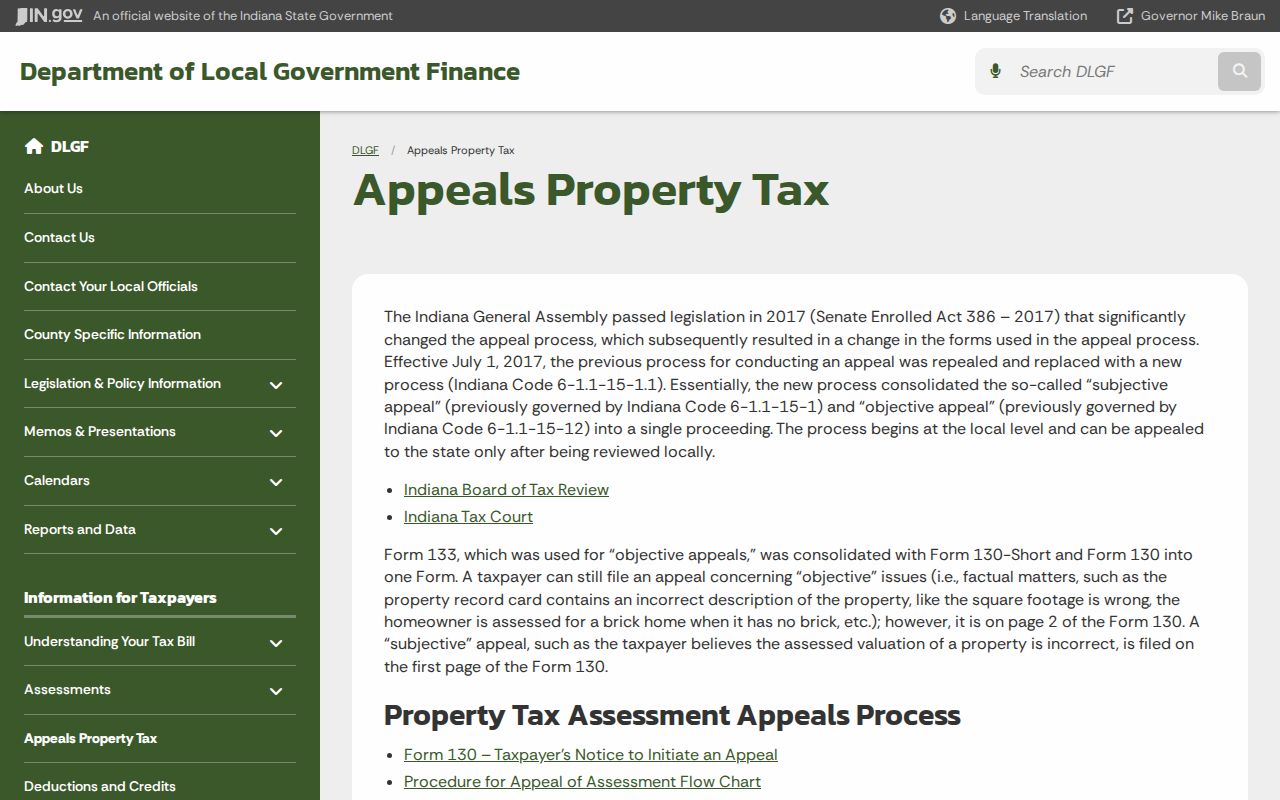
Organize the record and evidence first. Form 130 goes smoother when error types and escalation stages are already clear from the appeal resource.
Use the notice date. Harrison assessment rights are deadline-sensitive. Read the current Form 11 and Form 130 instructions, then file with the local assessing official within the stated window.
Use the Harrison Tax Offices When Portals Fall Short
The office handles are straightforward. The Harrison County Assessor works from 245 Atwood Street NE, Suite 221, in Corydon, at 812-738-4280. The Auditor covers deed transfers, exemptions, tax mapping, tax sales, redemptions, and rates. That office sits in Suite 211 and answers at 812-738-8241. The Treasurer occupies Suite 213 at 812-738-2348. Each office keeps doors open Monday through Friday from 8:00 a.m. to 4:30 p.m.
Before calling, gather the details. Bring the full parcel number, Tax ID, map number, situs, and owner spelling. Include the tax year and the exact field you are questioning. When a formal record request is needed, Indiana's Access to Public Records Act guidance applies. Ask for identifiable existing cards, lists, notices, or payment records. Do not ask for an explanation the office would have to create.
Route each request to the right custodian. The Assessor handles valuation and prior-year search help. The Auditor keeps transfer, deduction, mapping, redemption, and tax-rate records. The Treasurer manages bills, collections, delinquency, and payment status. Keeping requests separate prevents a payment question from being mistaken for an assessment challenge. It also gives staff a precise record to pull.
For a purchase review, save the current bill and balance. Check whether the displayed deductions could change with ownership. Verify any tax-sale notation, and record the retrieval date. Then compare the parcel identity with the deed. Do not assume the taxpayer line establishes title. For an appeal, build the file around the specific claimed error. Add evidence tied to the relevant valuation date.