
Compare Harrison Property Value Types
Indiana assesses real property at 100% of market value-in-use, yet the labels on an assessment card describe separate figures. The assessment is administrative. It exists for the tax system. A sale amount comes from one recorded transfer, while a private appraisal is a dated opinion prepared for a stated purpose.
| Value Type | What It Means | Where It's Recorded |
|---|---|---|
| Assessed value | Mass-appraisal value within the tax system | Assessor or Auditor card |
| Market value-in-use | Indiana standard based on the property's current use | Assessment method and notice |
| Last sale price | Amount tied to a prior transfer, if disclosed | Deed or transfer record |
| Appraised value | Dated opinion for a stated private purpose | Private appraisal, not the county roll |
The DLGF tests assessed values against sale prices annually. That never locks in a sale price. Trending and ratio work follow, but timing, condition, use, exemptions, and market terms can all keep a parcel's next sale far from its assessment.
Read Harrison Assessment Fields
The Auditor's sample card shows gross land assessment, improvement figures, deductions, taxable assessment, a gross-tax rate field, and tax charges. Preserve its labels and column structure. A text extraction can blur land, improvement, and total columns into one misleading figure.
Deductions shrink the amount subject to tax. They never touch sale price. Tax caps and rates likewise belong to calculation, not to market value. Keep gross assessment and taxable assessment in separate notes. Mixing them is the fastest way to misread a card.
The sample is dated 2025 payable 2026. Write both year labels whenever you compare Harrison County property value records.
Place Harrison at Full Assessment
The Indiana DLGF overview describes a 100% assessment level. It uses a market value-in-use framework. It also explains the state's annual sales research and ratio work. "Full assessment" is the legal valuation level. It is not a promise that the tax roll predicts a negotiated price.
Mass appraisal applies shared methods across many parcels at once. A private appraiser inspects one property. They select evidence for a specific date and purpose. Match each source to the question rather than crowning one number as universally correct.
Track Harrison's 2026 Reassessment Cycle
Indiana's statewide cyclical reassessment begins July 1, 2026 for 2026 Pay 2027 and runs across the following four years. Counties physically inspect roughly 25% of parcels each year. The goal is steadier workloads and more accurate records.
A Harrison parcel card can change for several reasons. Its cycle segment, annual trending, new construction, an appeal, or a data correction can each move the numbers. Record the assessment year and retrieval date. Never assume every parcel changes in the same year or by the same amount.
Annual trending has shaped Indiana's assessment system since 2002. Sales research can move values between inspection years. "Not inspected this year" therefore does not mean "value cannot change," so confirm the assessment date and trending period before comparing two parcel cards.
Estimate Harrison Property Value Records
Begin with the parcel, not a broad neighborhood estimate. The Auditor tax list accepts a property or parcel number, name, and property address clues. Beacon offers the county map route. A rural address or split parcel may still need a Tax ID, map code, or legal description.
- Search the Harrison Auditor tax list or Beacon by address or parcel.
- Confirm APN, Tax ID, situs, legal description, and assessment year.
- Copy gross land, improvements, deductions, and taxable assessment under their exact labels.
- Search the Recorder for the matching transfer when a sale amount is relevant.
- Assessed value
- The mass-appraisal figure assigned within the tax system.
- Market value-in-use
- Indiana's value standard based on current use.
- Assessment ratio
- A comparison of assessed values with sale prices across studied property.
- Consideration
- The amount stated for a transfer when the instrument discloses it.
- Reassessment
- A review that updates parcel facts and valuation on the state cycle.
The Harrison County Assessor can help with prior-year and other property searches when given a name, address, or Tax ID. Ask the office when a portal result is unclear.
Compare Harrison Sale Records
A last sale price belongs to one instrument on one date. The Recorder indexes by grantor, grantee, recording range, parcel ID, subdivision, or metes-and-bounds clue. So read the deed image itself rather than trusting the line. An index entry can omit terms, and not every conveyance reflects an open-market sale.
Family transfers, estate deeds, quitclaim deeds, partial interests, and entity reorganizations all record. But none of them set a market benchmark. Match the instrument to its parcel's assessment year. Never compare by street name alone.
The Recorder's Tapestry guide lists a pay-as-you-go index and image search for occasional users. Laredo serves subscribers. The county publishes no earliest online year. When a sale comparison depends on an older transfer, request the deed book or index at the Recorder instead of assuming the remote history is complete.
Use Harrison's Form 11 Date
The Form 11 notice starts the appeal clock. It marks the assessment that begins each year's tax and appeal process and gives a dated, official point for comparing the public card with the owner notice.
Amount questions go to the Assessor. Objective errors and appeals follow the DLGF route. The property-tax page covers that procedure in depth. For value research, keep the notice date, assessed amount, parcel identity, and any later changes together.
An objective error could be the wrong person listed as owner of record. It could be a missing exemption. Or it could be a math slip, or a bad legal description. That distinction explains why one public value may later be corrected. A correction is not a sale price.
The DLGF Form 11 explanation shows the state source behind the Harrison County assessment notice. Check it before questioning the card.
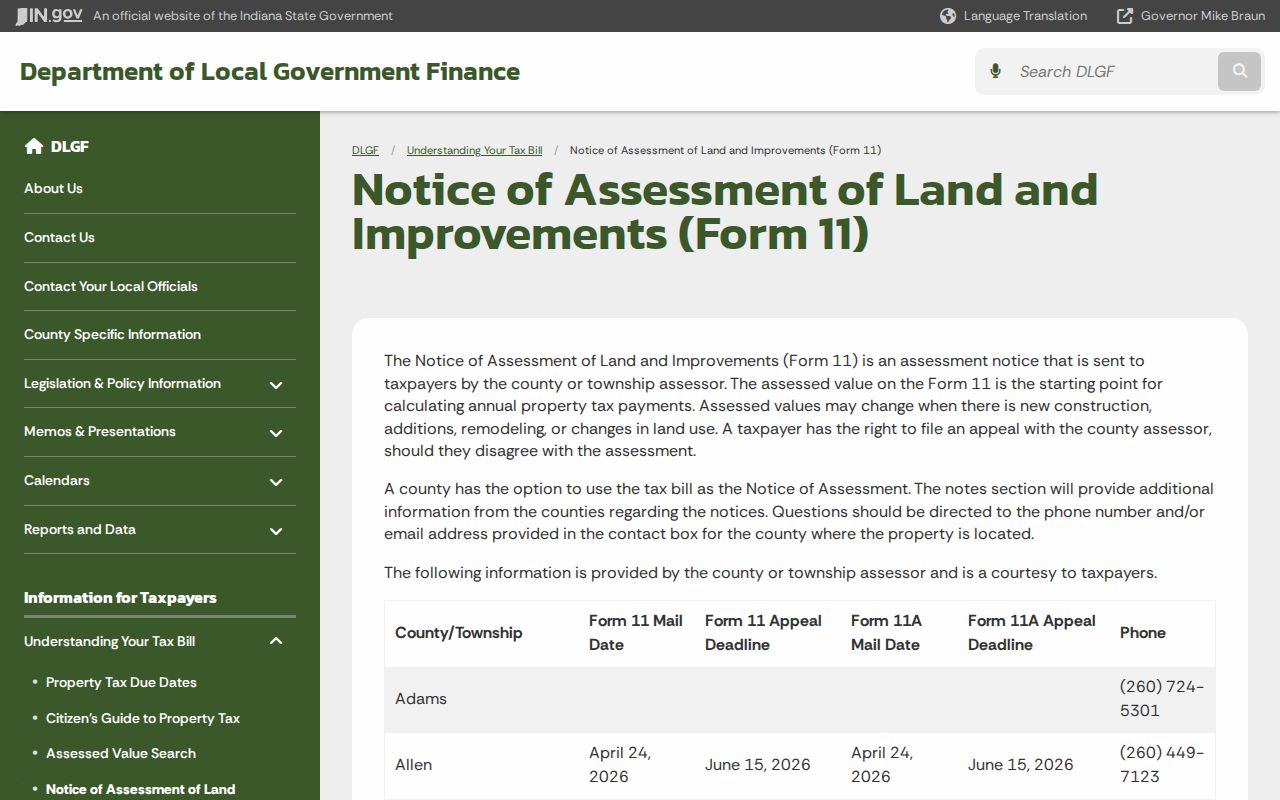
The notice date and parcel anchor any cross-year comparison.
Know the Practical Harrison Assessed Property Value Limits
An assessed value is not a sale price. It is not an offer or a replacement-cost figure. Harrison County never intends it as a parcel-specific private appraisal, and it proves nothing about condition, legal access, zoning permission, easement scope, or a precise boundary. GIS polygons help you locate the right card. Still, the map shape is not a value opinion. Planning documents can flag growth issues, yet they cannot predict the price of one parcel, so hire a licensed appraiser when you need a current, property-specific opinion.
Value is not price. Harrison County assessed value serves the tax system. It is not what the property must sell for and is not a private appraisal.
Keep five things together: source, parcel, date, value type, purpose. That small record matters. It keeps assessed, taxable, market, and sale figures from blending into one false number.
A good Harrison County valuation worksheet gives each figure its own row. Start with gross land, gross improvements, and total assessment. Then list deductions, taxable assessment, stated sale consideration, and any private appraisal separately. Note the assessment and payable years. Instrument date, recording date, and retrieval date belong there too. A number must tie to a labeled field. Otherwise, never present it as an official property value.
Changes also need a source. Corydon or county permit records may reveal new work. A split, replat, or zoning action can change the parcel context. That can explain why values differ between years. But none of these records supplies a price by itself. When a comparison affects a purchase or formal decision, confirm the current card with the Assessor.